Tuesday, April 5, 2016

A Helpful Reminder


Image result for brain picturesCertainly most readers of our blog forget very little of what they read here.  However, there may be a few of us who need to "prod the mind" just a bit at times.  Perhaps these are some useful reminders.... about the features of this Norchester Garden Club - ABCS blog.

The blog posts display differently on a laptop or desktop than they do on a tablet or cell phone.  Some of the features do not show up the same or at all. And each kind of computer or tablet may also display things differently..  The following assumes one is using a computer but many tablets will offer the same features. 

Email notice of what is posted here.  Add your email to the box in the right hand column of a post and whenever a new one is added, you will get an email version of it.

Also along the right hand side of a post is a list of "Archives".  The blog has been posted over 180 times since the first one in Feb of 2011.  The first post was a brief history of the Butterfly Garden and the second a brief history of Matzke Park.   Another useful past post is October 29, 2015.  Here I describe how you can support the butterfly garden by signing up with Kroger or Randalls or both. As of April 2016 there are still only 12 families signed up.  Surely we can do better than that. Even so, the check for the last three months was for $59.84 and it all goes to the Garden through the Garden Club. 

One can click on a year or month and see just what was posted. There is a lot of interesting information in the past posts saved in the Archives. 

Also along the right hand column is a list of "Links we Like".. these take you to other web sites that have garden-related information that seemed worth noting.

At the top of the "Links" list is the link to a menu of all the "mostly monthly" Horticulture Reports of the Norchester Garden Club for the past few years.  Just click on it and the menu opens up showing the year, month, and content for each report and  each has a link you can just click to open the report right up.  Now.. what you see when you do this is a "view" of the report file.  You can zoom it out to make it easier to read, you can print it, and you can download it to your own computer if you like. You can't change it and you can't hurt anything playing around with it. Usually at the top of the screen you will have words or small icons for print, save, download, etc... 

The "Comments" option is found at the end of each blog... although hardly anyone ever leaves one.  If you see "No Comments" after earlier blogs, just click on it and leave one.. you can do it anonymously if you choose. If you found any of this post useful... please leave a comment so I know someone reads this stuff. And click the "I am not a robot" box so your comment will be posted. 

Monday, April 4, 2016

The Invasion

Well.. perhaps just the start of an invasion.
 
If you have lived in the warmer areas of the US this is not new to you.  However there are some Yankees in our midst and they might need to be clued in.  Janet reported at the work day this morning  that this is showing up in the Matzke Park Butterfly garden. She suggested we get the word out.  So all hands on deck next time you are garden viewing and let’s get rid of this stuff.  Else, the garden could soon look like the banks of a Louisiana bayou. 

Kudzu’s root, flower, and leaf are used to make medicine. It has been used in Chinese medicine since at least 200 BC. As early as 600 AD, it was used to treat alcoholism. And that’s, that as far as positives go

Kudzu is a vine. Under the right growing conditions, it spreads easily, covering virtually everything that doesn’t move out of its path. Kudzu was introduced in North America in 1876 in the southeastern U.S. to prevent soil erosion. But kudzu spread quickly and overtook farms and buildings, leading some to call to kudzu "the vine that ate the South.”

Let’s not let it eat Matzke Park. Go for the “crown.”
Kudzu spreads by runners that root at the nodes to form new plants and by rhizomes. But for successful long-term control of kudzu, it is not necessary to destroy the underground system, which can be extremely large and deep. It is only necessary to use some method to kill or remove the kudzu root crown and all rooting runners. The root crown is a fibrous knob of tissue that sits on top of the roots. Crowns form from multiple vine nodes that root to the ground, and range from pea- to basketball-sized.  The older the crowns, the deeper they tend to be found in the ground. Nodes and crowns are the source of all kudzu vines, and roots cannot produce vines. If any portion of a root crown remains after attempted removal, the kudzu plant may grow back.
It is necessary to destroy all removed crown material. Buried crowns can regenerate into healthy kudzu. Transporting crowns in soil removed from a kudzu infestation is one common way that kudzu unexpectedly spreads and shows up in various locations… like your back yard.


Friday, April 1, 2016

Children's Program at Matzke Park Butterfly Garden Update

The Norchester Garden Club will be presenting  "Catherine the Butterfly" about the Monarch life cycle at the park for 89 daycare children during the month of April and May. Congratulations to Joan who has chaired this program from the beginning.    THANK YOU to all of those that has signed up for Kroger Rewards.  THIS quarter rewards are $59.84 that support Matzke Butterfly Garden and Children's Programs. Come Enjoy!
Picture by Meda

Thursday, March 31, 2016

Norchester Garden Club Meeting - April 7, 2016

Norchester Garden Club Meeting with speaker Bob Patterson from Southwest Fertilizer Lawn and Garden

Please join us for the next Norchester Garden Club Program on April 7, 2016 at 9:30 a.m. at the Norchester Activity Center, 13439 Jones Rd, Houston, TX 77070.  

All are welcome. Our garden club membership include those from Norchester, Tower Oaks Plaza, Lakewood Forest, Hunters Valley, Anderson Woods, Cypress Forest Estates and Tomball.   


Bob Patterson from Southwest Fertilizer Lawn and Garden will be speaking on organic gardening. He will also answer questions on house plants and tree care (pruning, diseases).

You can stay up to date with Norchester Garden Club (NGC) activities and other information on this blog by adding your email to the box in the right hand column of this post.  You will then get an email version of any new post sent to you the very next day. Things do display a bit differently on a computer, tablet, and in an email but the information is there.

Thursday, March 24, 2016

Welcome Spring

It's wonderful to have a nice back yard in Houston.  We are thankful.... and for the one whose care makes it beautiful.

Wednesday, March 16, 2016

Program for Children's Groups

One of the on-going projects of the Norchester Garden Club supports our purpose to develop, maintain, and promote the Matzke Park Butterfly Garden. The Children's Program was created to provide a no-charge, hands-on learning opportunity for young children's groups such as: school children, day care children, and children with special needs..  As a registered Monarch Butterfly site and staffed with our volunteers from Norchester Garden Club, children will be able to walk or wheelchair through the garden, listen to a story on the Monarch's life cycle, participate in a scavenger hunt of butterfly life stages and learn to be a good steward of the garden.

 Listen to a story of "Catherine the Caterpillar" (life cycle of Monarch Butterfly).

Available Dates are:  
April 21  9 a m
May 6     9 a m
May 6     11 a m

Please contact Joan at 281-469-3173 for more information and scheduling a time for your group.


Monday, March 7, 2016

Not Monarchs

This information is from texasbutterflyranch.com.  And we thank them.

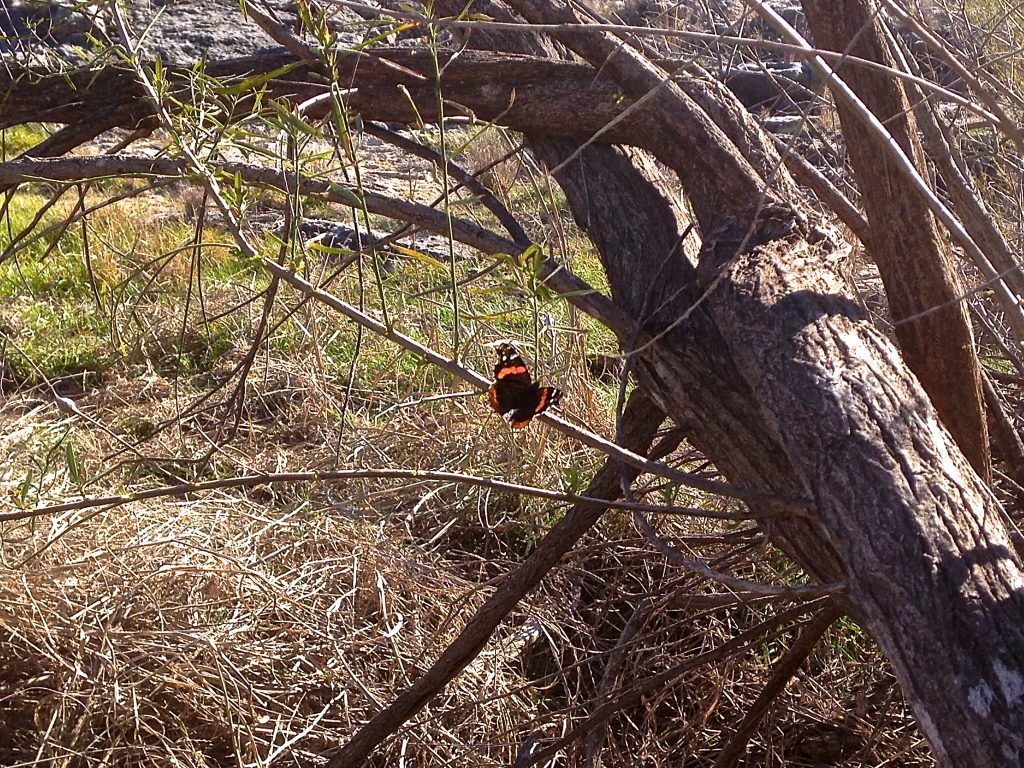
While we’re waiting for Monarch butterflies to leave their roosts in Mexico and make their way through South Texas, let’s take a moment to appreciate Red Admirals, a striking member of the Linnaeus family.

Red Admiral on tree

They show up early in the butterfly season. They host on pellitory and members of the nettles family. In the caterpillar stage, they appear blackish-grey with white flecks and harmless spikes.  Their chrysalis looks like a twisted, gold-dusted dead leaf.

Red admiral chrysalis

Red Admirals also have a reputation as one of the “friendliest” butterfly species.
“Unmistakeable and unforgettable,” reads the description of Red Admirals in the National Audubon Society Field Guide to Butterflies of North America. “The Red Admiral will alight on a person’s shoulder day after day in a garden.” Stories of the small butterflies landing on shoulders, hats and fingers, “riding” with humans are not uncommon.
If you think you might enjoy raising Red Admirals at home, check out the free tutorials on how to do so made available by the Association for Butterflies, an educational organization for hobbyist and commercial butterfly breeders.